
We have received a number of questions about why we disputing our fine and the things that are happening here in our community, what happened to our family, and what we have done to try to resolve these issues.
We believe those are fair questions and want to answer them as best as we can.
Getting Involved
How can I help?
There are several ways you can help, and none of them require agreeing with us on every issue.
One of the most important things anyone can do is become informed. Read the governing documents, attend open Board and committee meetings, ask questions, and request clarification when something does not make sense.
You can also help by sharing Voices of Hideaway with other members and encouraging them to review the information, documents, and concerns for themselves.
If you have experienced something similar, or if you have documents, emails, screenshots, meeting records, photographs, videos, or other information that may help provide context to an issue discussed on this website, we would like to hear from you. If you wish to remain confidential, please let us know when you contact us.
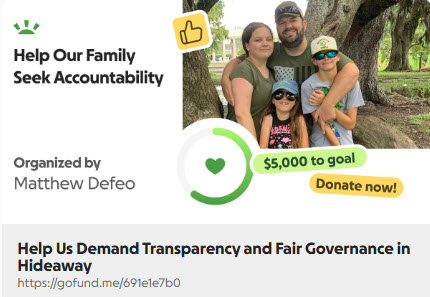
You can also support our efforts by donating to our GoFundMe. Funds raised will help us pursue accountability, including efforts to ensure the HOA follows its own bylaws, governing documents, and applicable state and federal laws.
Most importantly, we encourage everyone to remain respectful.
Our goal is not harassment, personal attacks, or creating division within Hideaway. We want members to ask questions, examine the records, participate in their community, and expect accountability from everyone involved—including the HOA, its leadership, and us.
Accuracy matters. Transparency matters. Accountability should apply to everyone.
Related:
Contact Voices of Hideaway
GoFundMe – Help Us Hold Hideaway HOA Accountable
What can other Hideaway members do if they have experienced something similar?
Document EVERYTHING that happened.
Save letters, emails, screenshots, account statements, notices, citations, photographs, videos, and anything else connected to the issue. Write down important dates and what happened while you still remember them.
Read the applicable governing documents and ask the HOA to identify the specific rule or authority being relied upon.
You are also welcome to contact us. We are especially interested in learning whether what happened to our family was an isolated situation or whether other members have experienced similar issues.
Related: Contact Voices of Hideaway

Why We Are Speaking Publicly
Why are you making this public instead of handling it privately with the HOA?
We tried to handle these issues privately first. We appealed the $500 charge, communicated with management and Board members, requested records, attended HOA meetings and are now seeking legal counsel.
We did not start Voices of Hideaway as our first response. We created it after a year of trying to obtain answers and resolve concerns through the HOA’s existing processes.
At this point, we believe members should be able to see the documents, timelines, and information for themselves.
Have you tried resolving this directly with the Board or management?
Yes.
We have communicated directly with management and Board members, appealed the fine, requested records, attended meetings, and attempted to raise our concerns through established HOA channels.
Unfortunately, most of the questions that started this dispute remain unanswered.
That is one of the reasons we began documenting our experience publicly.
What are you hoping to accomplish by talking about this?
Our goal is not simply to complain about what happened to us. We want to inform other members, help people who may be dealing with similar situations, and make it easier for members to understand their rights, the HOA’s procedures, and the governing documents that affect all of us.
What started with our own experience quickly raised much broader questions about how fines are issued, how appeals are handled, how suspensions are imposed, what authority security has, what records members are entitled to see, and how decisions are made and communicated.
We want clear answers, greater transparency, consistent enforcement of the governing documents, fair and understandable procedures when members are fined or suspended, and accountability when mistakes are made.
We also want members to know what is happening inside their community. Many people may never encounter these processes until something directly affects them. By documenting what happened to us, sharing the records we have obtained, and explaining the questions we continue to raise, we hope other members will be better prepared to recognize an issue, ask informed questions, preserve their own records, and know where to look for answers.
We are not asking anyone to automatically agree with us. In fact, one of the reasons we created Voices of Hideaway is so people can review the information for themselves.
Our hope is that members will read the documents, consider the facts, ask their own questions, participate in the community, and reach their own conclusions.
If what we have experienced can help another member better understand the process, avoid confusion, document their own situation, or feel more confident asking questions, then sharing our experience has served a purpose beyond our own dispute.
Are you going to run for the board?
No. I (Matt) have absolutely no desire to run for the Board. None.
I have already spent a significant part of my life serving my community. I gave 10 years of my life to public service, and I gave a lot of myself physically in the process. I have no desire to take on another position like that again.
I am also not doing this for pats on the back, attention, popularity, or any kind of social gain. I am not trying to build a following or position myself for a title.
I am trying to protect my family’s rights and yours.
I believe the rights we have were paid for with blood, sweat, tears, sacrifice, and in many cases, people’s lives both from our military and law enforcement. I have a great deal of respect for the people who came before us and gave so much so that others could have those rights.
Maybe I am out of the fight physically, but that does not mean I am going to stop standing up for what I believe is right. I will use what I still have available to me — records, documentation, questions, persistence, and my voice.
Voices of Hideaway is not about me or my wife gaining power. It is about asking the people who already have it to use it properly, follow the bylaws, follow the rules, be transparent with members, and respect the rights of the people they serve.
That is the fight I care about. Running for the Board is not even on my radar.
What about Chrissy?
Chrissy has expressed some interest in serving on the Board if her circumstances were different.
She works full time, and serving on the Board the way she would want to would require a serious time commitment. If she were not working full time, she might consider it more seriously.
For now, her focus is on her career, our family, and helping with Voices of Hideaway.
So while I have no interest in running for the Board, Chrissy has some interest. The biggest issue for her is simply having the time to do the job properly – which she does not have.
So, at this time, the answer for both of us is a firm no. Chrissy may be open to considering it someday if her circumstances change, but right now she is not interested in running.
Questions Regarding The $500 Uber Eats Fine
If the driver was speeding, why do you believe the HOA cannot charge your account?
Whether the driver was speeding and whether our household can be charged $500 for his actions are two different questions.
The driver was an independent Uber Eats delivery driver whom we did not employ, supervise, or control. We ordered food from UberEats app. They chose the driver, they work with the driver. We have no control over who, they are nor can we advise them on how to drive.
Our reading of the HOA’s governing documents is that certain community service providers, express deliveries including food-delivery services serving large numbers of residents, are treated differently from personal guests when determining member responsibility.
We have repeatedly asked for the specific provision authorizing the HOA to take a citation issued to the driver and place a $500 charge on our member account.
The rules state:
“Community Services Providers. Community services providers include governmental agencies, public safety personnel on official business, utilities maintenance personnel, and major delivery services utilizing clearly marked agency or company vehicles and appearing to be legitimate occupants of such vehicles. Specifically included in this category are school buses, postal deliveries, express service deliveries, newspaper deliveries, law enforcement officers, firefighters, emergency medical responders, and health and food delivery companies serving a significant number of residents.”
Related post: $500 Fine Added to Our Account Even Though the Bylaws Say We Aren’t Responsible
Are you saying the driver should not have been held accountable for speeding?
No — not at all.
If someone violates a legitimate traffic or community rule, there should be an appropriate process for addressing it. In this situation, our position is that traffic enforcement of this nature should be handled by properly authorized peace officers, not Class B licensed private security guards.
Our dispute has never been about excusing speeding. It is about who had the legal authority to conduct the traffic stop, who had authority to issue the citation, what rule authorized the amount of the fine, and why a citation issued to an independent Uber Eats driver ultimately became a $500 charge against our household.
Those are separate questions from whether the driver was speeding, and they are the questions we believe deserve clear answers.
Related post: Uber Eats $500 Ticket / Traffic-Enforcement Authority
Has the HOA shown you the rule or bylaw authorizing the $500 charge?
Yes. The HOA’s position is that because we called the Uber Eats driver into the community, he became our “guest,” and we were therefore responsible for his actions and the resulting fine.
We disagree with that interpretation because the governing documents specifically create a separate category for Community Services Providers and expressly include food-delivery companies within that category.
The rules state:
“Community Services Providers. Community services providers include governmental agencies, public safety personnel on official business, utilities maintenance personnel, and major delivery services utilizing clearly marked agency or company vehicles and appearing to be legitimate occupants of such vehicles. Specifically included in this category are school buses, postal deliveries, express service deliveries, newspaper deliveries, law enforcement officers, firefighters, emergency medical responders, and health and food delivery companies serving a significant number of residents.”
The same provision continues:
“Community services providers may be provided access without a pass or decal, provided that Security may undertake random checks of identification for such persons.”
That distinction matters because the rules use very different language when discussing other types of service providers.
For Individual Service Providers, the rules specifically state:
“The requesting member is responsible for the actions of any service provider or employee for whom a pass is requested.”
For Short Term Service Providers, they state:
“The requesting member is responsible for the actions of any service provider (including that person or company’s subcontractors) or employee for whom access is requested.”
That responsibility language is expressly included for those categories. It is not included in the Community Services Providers provision quoted above.
Our position is that an Uber Eats driver performing a food delivery fits the rules’ description of a food delivery company and/or express service delivery, rather than simply becoming our personal guest because we ordered food.
That is why we continue to question the HOA’s interpretation. If every delivery driver automatically becomes a member’s “guest” simply because the resident requested the delivery, then we believe the HOA should explain how that interpretation fits with its own separate definition of Community Services Providers.
Related post: $500 Fine Added to Our Account Even Though the Bylaws Say We Aren’t Responsible
Did the driver have an opportunity to pay the citation before it was placed on your account?
There are actually several separate questions about how this $500 charge was handled.
The Uber Eats driver was stopped on August 29, 2025 and issued a citation stating that he owed $500.
Hideaway’s rules state that when a fine is issued to a non-member, payment is supposed to be allowed for a stated period before the charge is placed on the responsible member’s account.
Yet the $500 charge appeared on our account on September 4, 2025 — only six days after the traffic stop.
That means the full 10-day period stated on the citation had not expired before our account was charged.
There is also a question about how those 10 days were calculated. Were weekends and holidays included, or was the driver supposed to receive 10 business days? August 29 was a Friday, followed by a weekend and the Labor Day holiday. If additional notice was mailed, when was it actually sent, and when did the driver receive it?
Even if the HOA counted calendar days, the driver had not been given the full 10 days before the charge was moved to our account.
Who decided the fine was $500?
There is another major question.
Hideaway’s speeding rules do not list an automatic $500 speeding fine for this type of violation. For speeds above the amounts specifically listed in the fine schedule, the matter is supposed to be referred to the Board of Directors.
The driver was accused of traveling 48 mph in a 25 mph zone — exactly 23 mph over the posted limit.
That exact speed creates another important question: how was 48 mph determined?
Based on the information we have, we believe radar or another speed-measuring device may have been used. We have also raised questions with the Texas Department of Public Safety about the authority and training of private security officers to conduct traffic-enforcement-type stops.
Texas DPS regulates private security under Chapter 1702 of the Texas Occupations Code. DPS describes private-security duties as including protecting property and, in certain circumstances, controlling or directing traffic as necessary to protect that property. Private security officers are not the same as licensed peace officers.
We have also been told by DPS that the security personnel involved were not trained by DPS as law-enforcement officers to conduct traffic stops or radar-based speed enforcement.
That leaves a basic question:
What authority did Hideaway Security rely upon to measure a driver’s speed, stop and detain the driver, and issue what functioned like a speeding citation?
And when was the $500 amount approved?
The original citation already stated $500.
That is significant because the speeding schedule itself does not appear to establish $500 as an automatic fine for traveling 21 mph or more over the limit. Instead, that level of violation is referred to the Board.
So when did that Board referral happen?
- Was the Board consulted before the citation was written?
- When did the Board decide the fine should be $500?
- Was there a meeting, motion, or vote?
- What record documents that decision?
- How was the $500 amount calculated?
- Was the decision made before or after the traffic stop?
- If the Board had not yet considered the violation, who authorized Security to place $500 on the citation?
If the rules require the matter to be referred to the Board, we believe there should be a record showing when the referral occurred, what the Board considered, and how the amount was determined.
Why were we responsible for the Uber Eats driver at all?
This may be the most important question.
Hideaway’s governing documents contain provisions addressing community service providers and delivery services that serve residents throughout the community.
Think about it this way:
If an Amazon delivery driver was speeding while delivering a package to your house, would you expect the driver’s speeding fine to be placed on your HOA account simply because your home happened to be the delivery destination?
We wouldn’t.
That is exactly why the community service provider provision matters.
Amazon, UPS, FedEx, food-delivery drivers, utility workers, plumbers, contractors, and other service providers enter Hideaway to provide services to residents. A resident may be the reason a driver enters the community, but that does not necessarily make the resident responsible for everything that independent driver does while operating their own vehicle.
Uber Eats is a delivery service too.
So why was this driver treated differently?
If an Amazon driver would be considered a community service provider, why wouldn’t an Uber Eats driver delivering food to a resident fall under the same provision?
And if the HOA believes Uber Eats is excluded, then we believe the HOA should be able to point to the specific rule that creates that distinction.
That is why this issue is about much more than whether the driver was speeding.
It is about:
- whether we were responsible for the driver in the first place,
- what authority Security had to conduct the stop and determine the driver’s speed,
- who authorized the $500 amount,
- whether the required Board referral actually occurred,
- whether the driver received proper notice,
- and why our account was charged before his stated payment period had even expired.
Related post: $500 Fine Added to Our Account Even Though the Bylaws Say We Aren’t Responsible
Where do the bylaws or rules say you are not responsible for an Uber Eats driver’s actions?
The governing documents do not specifically use the words “Uber Eats.” The stronger point comes from how Hideaway’s Rules & Regulations classify different types of service providers.
Under Article III — Security, Section Two — Access, subsection 4 — Service Providers, the rules create a category called “Community Services Providers.”
That section specifically says community service providers include “health and food delivery companies serving a significant number of residents.” It also includes major delivery services, postal deliveries, express service deliveries, utilities, emergency responders, and other services that regularly serve the community.
The same section says these community service providers may be allowed access without a pass or decal, subject to identification checks by Security.
That matters because the rules separately define Individual Service Providers and Short Term Service Providers.
For those categories, the rules specifically state that the requesting member is responsible for the actions of the service provider for whom access is requested.
The Community Services Provider section does not contain that same responsibility language.
That creates an important distinction.
An Uber Eats driver is a food-delivery driver. We did not employ him, supervise him, control his vehicle, tell him how to drive, or direct his actions. We simply ordered food.
So our question is:
Why was this Uber Eats driver treated as though he were our personal guest or individually sponsored service provider, rather than as a food-delivery company under the Community Services Provider rule?
Think about it another way:
If an Amazon, UPS, FedEx, or grocery-delivery driver allegedly violated a traffic rule while delivering to your house, would you expect that driver’s fine to automatically become yours simply because your address was the destination?
That is why we believe the classification matters.
The rules specifically recognize food-delivery companies as Community Services Providers, while other service-provider categories expressly make the requesting member responsible for their actions.
So the issue is not that the rules literally say:
“Members are never responsible for Uber Eats drivers.”
The issue is that the rules appear to place food-delivery companies in a separate category, and we have not been shown a clear rule explaining why this Uber Eats driver was treated differently or why his alleged violation was transferred to our account.
If the HOA believes Uber Eats does not fall under the rule that specifically includes health and food delivery companies, or express deliveries then we believe it should identify the exact rule that says why.
Security and Traffic Enforcement
Are you claiming HOA security cannot enforce speeding rules at all?
Yes and no — in our opinion, Hideaway can have rules prohibiting speeding, but its private security officers do not have the authority or law-enforcement training to conduct police-style traffic stops. According to information we received from DPS, the private-security training did not include conducting traffic stops or issuing traffic tickets.
Because of that, we do not believe private security guards should be enforcing speeding rules by using methods that resemble or mimic law-enforcement traffic stops.
That includes conduct such as signaling a driver to pull over, detaining the driver, using radar or other speed-detection equipment for enforcement, demanding identification, and issuing what appears to function as a traffic citation.
Our concern is that when private security officers use police-like methods, equipment, terminology, or appearance, it can create the impression that they are exercising law-enforcement authority they may not actually possess.
That is why we have also raised questions about whether this type of conduct could cross the line into impersonating or presenting oneself as a police officer or public servant.
We are not claiming that a criminal offense has been proven. We are saying the conduct raises a serious question that deserves a clear legal answer.
We also have a prior legal opinion from attorneys who represented the HOA advising that Hideaway Security should not be conducting traffic stops.
So our position is simple:
Hideaway can have a rule against speeding but has limited ways of enforcing it.
But does private security have the authority to enforce that rule by acting like law enforcement?
What authority do you believe HOA security does or does not have regarding guards?
The governing documents give HOA security responsibilities relating to protecting HOA property, controlling access to the community, identifying people entering Hideaway, and carrying out other security-related functions.
What we have not found in the governing documents is language specifically authorizing security personnel to conduct traffic stops for ordinary moving violations, use radar or other speed-detection equipment for enforcement purposes, activate warning lights to stop motorists, issue speeding citations, or impose monetary penalties for those alleged violations.
That distinction is important.
Controlling access to a private community is very different from operating what appears to function as a traffic-enforcement system. Stopping a vehicle because security needs to determine who is entering the community is one thing. Stopping a motorist because a guard believes the driver was traveling a specific number of miles per hour over the speed limit, issuing that driver a citation, and later attaching a monetary penalty to a member’s account raises a different set of questions.
In our case, the Uber Eats driver was told he was being stopped because he was allegedly traveling 48 mph in a 25 mph zone. The stop was therefore not simply an identification or gate-access check. It was conducted specifically because of an alleged moving violation.
We have also questioned the use of radar or speed-detection equipment, security vehicles with warning lights, written citations, and a system through which those citations can ultimately result in charges being placed on a member’s account.
There is also another reason we question whether roadside identity stops are necessary.
Hideaway already controls access through staffed or monitored entrance gates. Visitors and service providers are checked when they enter, and Security collects or records identifying information as part of that process. We have also personally observed a driver’s-license image displayed on a guard-shack computer monitor, and during the Uber Eats incident a field guard was able to radio the gate and obtain the delivery destination, including our name and address. That suggests Security already has access to substantial visitor-entry information once someone has entered the community.
According to HOA records we have reviewed, Hideaway has also reported no recent “gate runner” problem associated with the gated entrances. If people entering the community are already being identified, their vehicles recorded, and their destination information retained or accessible, then it raises another question:
Why should a guard need to pull someone over later simply to determine who that person is?
If Security already knows who entered, when they entered, what vehicle they were driving, and where they were going, then the stated need for roadside identification appears much weaker.
Our concern is not that Hideaway should ignore unsafe driving. Speeding can create a genuine safety issue, and we support reasonable efforts to keep the roads safe.
The question is who is legally and contractually authorized to perform that enforcement and what authority the HOA is relying upon when private security personnel perform functions that resemble traditional traffic enforcement.
That concern is especially significant because we also have a prior legal opinion from attorneys who represented the HOA advising that Hideaway Security should not be conducting traffic stops.
That raises a simple question:
If the HOA’s own attorneys previously advised against conducting traffic stops, so why did the practice continue?
That is why we have requested records concerning security policies, training, equipment, citation procedures, legal authority, visitor-entry records, gate-access systems, and the rules used to justify these practices.
If the HOA believes its governing documents authorize security guards to conduct traffic stops, use radar, issue speeding citations, and impose monetary penalties, we believe members should be able to see the specific provisions granting that authority.
And if Security already has reliable gate-entry records showing who entered Hideaway and where they were going, we believe the HOA should also explain why roadside stops for identification are still necessary.
Related post: $500 Fine Added to Our Account Even Though the Bylaws Say We Aren’t Responsible
The Appeal and HOA Records
Did you appeal the $500 fine? What happened?
We expected an opportunity to explain why we believed the charge was inconsistent with the governing documents and to present our supporting evidence.
Instead, the hearing became confrontational before we completed our presentation. Security was called and we were removed.
The written decision we later received did not resolve several of the central questions we had raised, including the authority for placing the driver’s citation on our member account.
Related post: Raised Voices, Security Called, and Our Appeal Stopped Before We Finished Presenting Evidence
Why are you requesting HOA records?
As we began looking more closely at how decisions were being made inside Hideaway, we developed questions about financial management, Board approvals, contracts, property transactions, assessments, expenditures, security practices, suspensions, closed meetings, and the General Manager’s land purchases within the community.
Many of those questions simply cannot be answered without seeing the underlying records.
For example, we want to better understand how member money is being collected, spent, approved, and accounted for. That includes budgets, financial statements, expenditures, assessments, clubhouse-related charges, checks, contracts, reimbursements, and other financial records that can show where money went and what authorization existed for particular transactions.
We also have questions concerning property transactions involving the General Manager.
Public property records show multiple land transactions involving General Manager Del Polikretis and his wife. We have also identified HOA records and Board actions that appear relevant to some of the property issues we have been researching. We are not claiming that purchasing property in Hideaway is itself improper.
What we want to understand is whether there were any HOA transactions, approvals, expenditures, agreements, relationships, or decisions connected to those properties—and, if so, whether those matters were properly disclosed, authorized, documented, and handled in accordance with the governing documents.
That is exactly why records matter.
We have also requested meeting minutes and closed-meeting records because they can help establish when decisions were actually made, who participated, whether a vote occurred, what authority was relied upon, and whether the written record matches what members were told at the time.
The same applies to our questions about security and traffic enforcement. We want to see the policies, training records, procedures, equipment records, citation practices, and other documents showing what authority security was operating under.
Our records requests therefore cover a much broader range of issues, including:
- HOA financial records and expenditures
- Budgets, assessments, fees, and accounting records
- Contracts and agreements
- Board votes, approvals, and meeting minutes
- Closed-session records and summaries
- Property transactions and related HOA actions
- Records concerning the General Manager’s land purchases
- Security policies and traffic-enforcement practices
- Our $500 fine and appeal
- Suspension and access records
- Member-account records
- Website records and publication history
- Correspondence relating to decisions affecting members
We are not requesting these records simply because we want more paperwork.
We are requesting them because records are how members determine whether decisions involving their money, their property, their rights, and their community were made properly.
Without the underlying documents, members are left relying on explanations after the fact.
With the records, we can compare what was said with what was actually documented, determine whether proper approvals occurred, understand how money was handled, and identify whether the HOA followed its own governing documents.
If everything was handled properly, the records should help demonstrate that.
If there were mistakes, inconsistencies, missing approvals, unexplained financial transactions, or procedures that were not followed, the records can help identify those as well.
That is ultimately what we are looking for: transparency.
We want members to be able to see the documents, understand how their HOA is being operated and how their money is being managed, and reach their own conclusions based on the records rather than rumors, assumptions, or competing versions of events.
Related:
Questions Grow After HOA Records Requests
GM Property Transactions Deserve Closer Scrutiny
Closed-Meeting Summaries Appear Later — Then Show Signs of Editing
Why are you requesting the General Manager’s contract?
We are requesting the General Manager’s contract because members should be able to understand the financial obligations the Board has agreed to on behalf of the Club.
We want to know what the Club is required to pay the General Manager, whether the contract includes bonuses or other incentive compensation, what conditions must be met for those bonuses to be paid, and whether there are additional benefits or financial obligations that members may ultimately be responsible for funding.
We also understand that the contract may include provisions requiring the Club to continue paying some or all of the remaining contract amount if the General Manager is terminated under certain circumstances. If that is correct, members should be able to understand the potential financial liability the Board has committed the Club to.
This is not about curiosity regarding someone’s private finances. It is about understanding how member money is being committed and what long-term financial obligations have been created on behalf of the membership.
We also have questions about the decision to extend the General Manager’s contract.
Many residents have publicly expressed concerns about management decisions and the direction of the Club. Given those concerns, we believe it is reasonable to ask why the Board decided to extend the contract, what performance measures or evaluations were considered, what financial terms were approved, and what information the Board relied upon when making that decision.
We also want to understand the timing.
- Why was the contract extended well before the existing contract was scheduled to expire?
- Was there a particular reason an early extension was necessary?
- Were alternative options considered?
- Was the General Manager’s performance formally evaluated before the extension was approved?
And perhaps most importantly, why was the membership not informed that a significant employment contract had been extended until after the decision had already been made?
When a contract potentially commits the Club to substantial salary, bonuses, benefits, or termination payments for years into the future, we believe members have a legitimate interest in understanding what the Board agreed to and why.
The Hide-A-Way Lake Club bylaws also specifically address employee contracts. Article VIII, Section One states:
“All contracts with any employee … All contracts shall be made available to a Club member on request.”
That is why we continue to request the contract and any extensions.
We are not asking the membership to assume the contract is improper. We are asking for the document so members can see the actual terms, understand the financial commitments that were made on their behalf, understand why the contract was extended when it was, and reach their own conclusions about whether the decision was in the best interests of the Club.
What records has the HOA refused or failed to provide?
At this point, the HOA has not provided any of the records we requested.
Our requests include financial records, Board approvals, meeting minutes, contracts, the General Manager’s contract, records relating to property transactions, security policies, suspension records, account records, and documents connected to the $500 fine and appeal.
These records matter because Texas Property Code § 209.005 generally requires property owners’ associations to make their books and records, including financial records, reasonably available to members, subject to certain legal exceptions.
The statute also sets deadlines for responding to proper records requests and allows owners to seek court relief when records they are entitled to receive are not produced.
We are asking for these records because they can show how member money was spent, what decisions were made, who approved them, what contracts were entered into, and what authority was relied upon.
Members should be able to evaluate those issues using actual documents, not just verbal explanations.
What does the body-camera/YouTube video have to do with the Uber Eats speeding ticket?
The HOA provided us with an unlisted YouTube link containing body-camera footage of the traffic stop.
That video is important because it documents what actually happened during the stop. It shows the security officer approaching the Uber Eats driver and stating that the reason for the stop was that he was allegedly traveling 48 mph in a 25 mph zone. It also helps document how the stop was conducted and how the citation was handled.
In other words, the video gives us direct evidence of the HOA security process instead of requiring us to rely only on someone’s later description of what happened.
It also raised a separate privacy concern. The materials the HOA sent us included personal identifying information belonging to the Uber Eats driver, including his driver’s-license number and home address, without redaction.
The video was later removed from YouTube, but we preserved the information we received.
That is why the video matters: it helps document the traffic stop itself, the actions of HOA security, and the way sensitive information connected to the citation was handled.
Related post: $500 Fine Added to Our Account Even Though the Bylaws Say We Aren’t Responsible
What authority do you believe HOA security does or does not have?
The governing documents give HOA security responsibilities related to protecting HOA property, controlling access, and identifying people entering the community.
What we have not found is language specifically authorizing security guards to conduct traffic stops for moving violations, use radar for enforcement, stop motorists with warning lights, issue speeding citations, or impose monetary penalties for alleged traffic violations.
That distinction matters. Controlling access to a private community is not the same thing as operating a traffic-enforcement program.
In our case, the Uber Eats driver was specifically told he was being stopped because he was allegedly traveling 48 mph in a 25 mph zone. This was not simply an identification or gate-access check.
We are not arguing that unsafe driving should be ignored. Our question is whether Class B licensed private security guards have the authority to perform this type of traffic enforcement, and what specific rule, policy, or legal authority the HOA relies upon when they do so.
If that authority exists, we believe members should be able to see exactly where it comes from.
Related post: $500 Fine Added to Our Account Even Though the Bylaws Say We Aren’t Responsible
Management, Property Transactions, and Governance
Have you attended committee meetings and open Board meetings to try to change things?
Yes.
We have attended committee meetings and open Board meetings and have tried to raise concerns through the HOA’s established processes.
In our experience, when we have attempted to speak or ask questions, we have been interrupted, redirected, or left without meaningful answers. Many of the issues we have raised have remained unresolved even after bringing them directly to the Board.
Because of that, attending meetings has become increasingly frustrating for us. At least in our experience, it has often felt as though our concerns are not being meaningfully considered and that decisions have already been made before we are given an opportunity to fully explain our position.
We will continue to stay informed and participate when appropriate, but our experience is one of the reasons we created Voices of Hideaway. We wanted a place where the questions we have raised, the documents we have gathered, and the issues we believe deserve answers can be presented fully and without interruption.
Why are you discussing the General Manager’s property transactions?
We are discussing the General Manager’s property transactions because we have been unable to locate records showing what process, if any, was followed when he purchased property within Hideaway while serving as the Club’s General Manager.
Residents are expected to follow established HOA procedures when dealing with property-related matters. Because the General Manager holds a leadership position within the organization, we believe it is reasonable to ask whether the same level of review, documentation, disclosure, and approval applied to his transactions.
So far, we have been unable to locate Board meeting records, announcements, or other documents showing that members were informed of the purchases or explaining whether any Board review or approval occurred.
We are not claiming that purchasing property in Hideaway is improper. Our concern is whether the proper process was followed and whether those transactions were handled transparently given the General Manager’s position.
If the appropriate procedures were followed, we believe the records should be able to show that.
Are you trying to remove Board members or HOA employees?
Our primary goal is accountability, transparency, and compliance with the governing documents.
This website is not about targeting individuals simply because we disagree with them. Its about stating what we’ve researched and know from first hand experiences and sharing it with the community.
If the evidence ultimately demonstrates that changes in leadership, policies, or personnel are appropriate, those decisions should occur through the proper Board, membership, employment, or legal processes.
Members should be able to make those judgments based on accurate information and not have to research, ask several times and then be retaliated against, in our opinion.
Dues, Suspensions, and Facebook Access
Were you behind on dues? Why?
Yes, we were behind on our dues for a period of time, and there were a few reasons for that. This is more personal, but we want to be transparent about it.
In June 2025, I began experiencing serious neurological symptoms that affected my ability to speak, walk, and control my muscles normally.
Over the following months, especially in December, January, and February, those symptoms became much worse. Doctors initially considered whether I may have suffered a several minor strokes, but I was later diagnosed with Functional Neurological Disorder (FND) and used that money we would normally pay for HOA dues for medical treatment.
During that same general period, we discovered that the public management information on the TREC website still listed Hideaway’s previous General Manager instead of the current one. We misunderstood what that filing problem meant and incorrectly believed that it affected our obligation to pay HOA dues.
We were wrong about that.
Once we understood that our interpretation was incorrect, we paid the full amount owed in July, including the late fees, finance charges, and other amounts that had accumulated.
My health also played a major role in how much I was able to stay involved during that period. There have been times when my symptoms have required emergency-room visits, and I still have periods when speaking, walking, typing, and general muscle coordination are difficult.
That is also why you may have seen less of me at open Board meetings or on Facebook at different times, and why I frequently use AI to help organize and communicate my thoughts in writing.
For me, it is simply a practical tool.
When my energy and mobility are limited, using assistance allows me to spend that limited energy researching documents, reviewing records, communicating with members, and continuing this work instead of exhausting myself trying to do everything manually.
We do not want to hide the fact that we fell behind on dues, and we are not trying to excuse it. We misunderstood part of the law while dealing with a difficult medical situation, corrected the mistake, and paid what was owed.
Transparency and accountability should apply to everyone—including us.
Related post: Gate Access Restricted Before Notice and Beyond the Stated Deadline
Why are you discussing suspension of amenities and gate access?
Because suspension is one of the mechanisms the HOA can use against members, and we believe members should understand exactly how that process works.
Our RFID access was disabled on July 6, 2026.
The certified notice concerning the delinquency was sent afterward, and we paid the full amount requested on July 9, 2026.
We were subsequently informed that reinstatement would not occur until August 1, 2026.
That raises questions about notice, timing, procedure, and the authority for continuing restrictions after the account had been paid.
Related post: Gate Access Restricted Before Notice and Beyond the Stated Deadline and Chrissy’s Access Restricted Without Separate Notice
About Voices of Hideaway
Can members submit information or documents to you confidentially?
Yes.
If you have information, documents, screenshots, correspondence, meeting information, or an experience you believe we should know about, you may contact us.
If you want your identity kept confidential, please clearly tell us when you contact us. We will make every reasonable effort to respect that request.
Related: Contact Voices of Hideaway
Will you publish someone’s name if they contact you?
Not simply because someone contacts us.
If you provide information confidentially, we will treat your request for confidentiality seriously.
There may be circumstances where information cannot responsibly be published without identifying its source or independently verifying it. In those situations, we may choose not to publish the information rather than expose someone who asked to remain confidential.
Related: Contact Voices of Hideaway
Can HOA employees, Board members, or people who disagree with you contact you?
Can HOA employees, Board members, or people who disagree with you contact you?
Absolutely.
Voices of Hideaway is not intended only for people who agree with us. If a Board member, employee, former employee, member, or anyone else believes something on this website is incorrect, incomplete, or missing important context, we want to hear from them.
We are willing to review documents, records, explanations, or other information that may help clarify an issue or correct the record.
What we are not interested in is responding to unsolicited calls, messages, or comments that simply attack our character, accuse us of lying without providing evidence, or tell us we are bad people for raising questions.
What would that accomplish?
We are not doing this to “look good,” win a popularity contest, or convince everyone to like us. We are doing it to document what we have found, preserve records, ask questions, and try to get accurate answers.
If someone believes we got something wrong, show us the record. If there is context we missed, provide it. If there is documentation that changes our understanding, we will review it.
And if we are wrong, we will happily correct what we have published.
But we need something we can actually evaluate.
Proof is not simply, “Sally told me that this happened,” or “someone at the HOA said this was okay.” Repeating what another person supposedly said does not allow us to independently determine what happened.
We are looking for things such as official records, emails, letters, policies, bylaws, laws, meeting minutes, recordings, videos, photographs, financial or government records, and firsthand accounts from people who personally witnessed or experienced the event.
A firsthand account is different from hearsay. If you were personally at the meeting, received the email, participated in the conversation, witnessed the event, or were directly involved, we want to hear from you.
We are not asking people to agree with us. In fact, if someone has credible evidence showing that something we published is wrong, we want that evidence.
Our credibility depends on being willing to correct mistakes.
But a correction should be based on evidence, not rumors, secondhand stories, personal attacks, or simply being told that we are wrong.
But personal insults, character attacks, and unsupported accusations do not help establish what actually happened nor does it help anything really except express how you feel.
Related: Contact Voices of Hideaway
Will you correct something on the website if you discover it is inaccurate?
Yes — absolutely.
Our credibility depends on being willing to correct mistakes when we discover them. We are trying to be as transparent as possible and provide members with the records, documents, timelines, and other information we are able to share.
At the same time, there are some things we cannot publish. Certain information may involve privacy concerns, confidential communications, legal strategy, personal information belonging to others, or documents that we have been advised not to make public.
That does not mean we are trying to hide information. It simply means there are limits to what can responsibly or legally be posted online.
If someone believes something on Voices of Hideaway is inaccurate, incomplete, or missing important context, we encourage them to contact us and provide the information supporting their concern. We will review it, and if we determine that something is wrong, we will correct it.
Our goal is not to prove ourselves right at all costs. Our goal is to present the most accurate picture we can based on the information available to us.
Related: Contact Voices of Hideaway
What We Are — and Are Not — Asking Members to Do
Who is paying for the website and legal expenses?
Voices of Hideaway is an independent effort created and operated by my wife, Chrissy, and me, Matt. We currently fund the website ourselves, and we have also created a GoFundMe to help with legal expenses and the costs of continuing this work.
This effort is not just about what has happened to our family. We are fighting for greater transparency, accountability, and fair treatment for Hideaway as a whole.
We believe members have a right to know who is behind the information being presented to them. That is why we openly identify ourselves, explain our connection to these issues, and are transparent about how this effort is being supported.
Why don’t you just sue the HOA?
We are currently speaking with lawyers about these issues, but at this point, what we want most is for the HOA to provide the records we have requested and answer the outstanding questions.
Filing a lawsuit is not a simple or inexpensive decision.
Based on the estimates we have received, litigation could cost approximately $40,000 to $60,000, and potentially more depending on how long the case lasts, how aggressively it is defended, how many witnesses are involved, and how much evidence has to be reviewed and presented.
That is a major financial burden for any family.
But there is another reason we do not view suing the HOA as being in anyone’s best interest unless it becomes absolutely necessary.
When a member sues the HOA, the financial impact does not stop with that member. It affects all of us.
The HOA has to pay lawyers to defend the case.
Those legal expenses are ultimately paid from Association funds.
If litigation contributes to higher insurance costs, those increases are also ultimately borne by the membership.
According to statements made by the General Manager, Hideaway has already had difficulty obtaining insurance because of the number of lawsuits involving the Club. We have also learned that the HOA’s insurance costs have increased by approximately 580%.
Every dollar spent on attorneys, litigation, and increased insurance premiums is money coming out of the Club’s resources—resources funded by you and I.
That is why we have spent so much time trying to resolve these issues through records requests, appeals, meetings, questions to the Board, communication with management, and now consultation with legal counsel.
We are not trying to create another expensive lawsuit if these issues can be resolved another way. But we will if we have too.
At the same time, the cost of litigation should not mean members are expected to simply accept being retaliated against and accept actions they believe are improper, inconsistent with the governing documents, or unsupported by the records.
What we would prefer is much simpler and much cheaper:
- Provide the requested HOA documents.
- Answer the outstanding questions and correct mistakes where appropriate.
- Explain the decisions that were made and the authority relied upon.
- Stop retaliating against us for raising concerns, requesting records, and questioning Association actions.
- Hold the people responsible accountable when rules, policies, governing documents, or duties were not followed.
- Allow members to see the information necessary to understand what happened and how these decisions were made.
Unfortunately, based on our experience so far, I am not confident that will happen without continued pressure from members and, if necessary, legal action.